Some years when we talk about social media trends, the focus is on creative formats that are rising in popularity. Other years, the focus is on the shifting sands of the platforms themselves. This is one of those years.
The environment has changed. Distribution has changed. Expectations have changed. And if churches are still publishing for the social landscape of three years ago, results will suffer.
Let’s not waste any time. Here are seven trends shaping church social media in 2026.
Too Much Content To Consume
On Meta platforms especially, the supply of content being published is outpacing the demand from users consuming it.
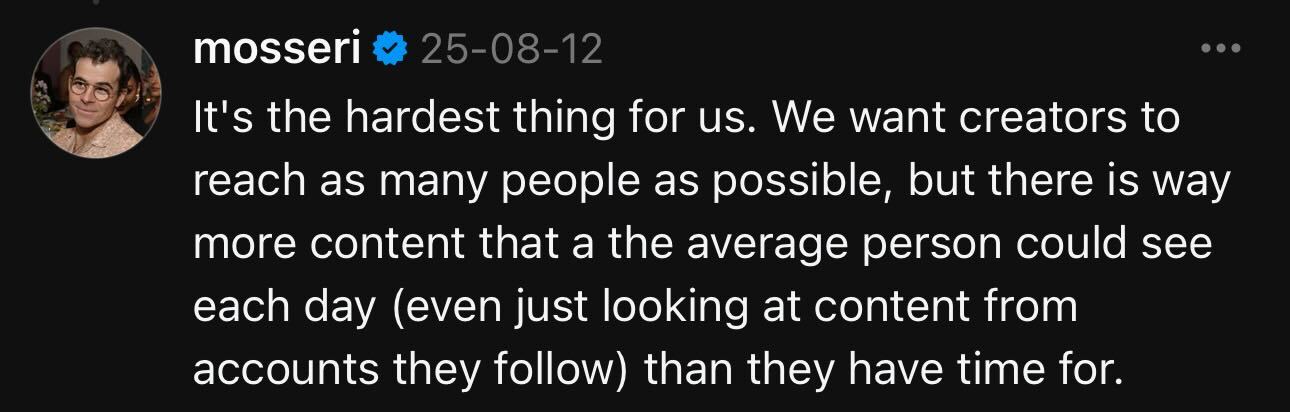
Adam Mosseri, the head of Instagram, has recently said this plainly.
There is far more content than the average person could ever see in a day, even just from the accounts they follow.
Think of it like the housing market. In some seasons, sellers have the advantage. In others, buyers do. The same house can have very different outcomes depending on the market conditions.
The same is true for your posts. A piece of content that would have performed exceptionally well in 2023 might perform very differently in 2026. That doesn’t mean you failed, but it does mean that the market has shifted.
The good news is, you don’t have to take it personally. You can simply adjust to the environment.
Go Ahead And Post More
In a supply heavy market, the simplest strategy is also the most effective. Post more.
We recently worked with a church whose impressions doubled in a single month. The strategy wasn’t complicated. We just published roughly twice as much content as they had been posting previously. Double the content equaled double the impressions.
And that’s because more content created more opportunities for distribution. More opportunities led to more reach.
I know this can feel unrealistic. Most churches already feel stretched. Which leads us directly to the next trend...
You Can Post That Again
Audit your posts from the past couple of years, identify the top performers, and then repost them.
Yep, you read that right – repost them. The same post with the same caption. Just send it again.
If a sermon clip from 18 months ago performed well, publish it again. Scripture is for all people for all time. There is nothing outdated about biblical truth.
From a platform standpoint, you are not penalized for reposting strong content. In many cases, it is one of the most efficient strategies available because you already know the format works.
Some of my most viral posts are exact reposts from ealier in the year.
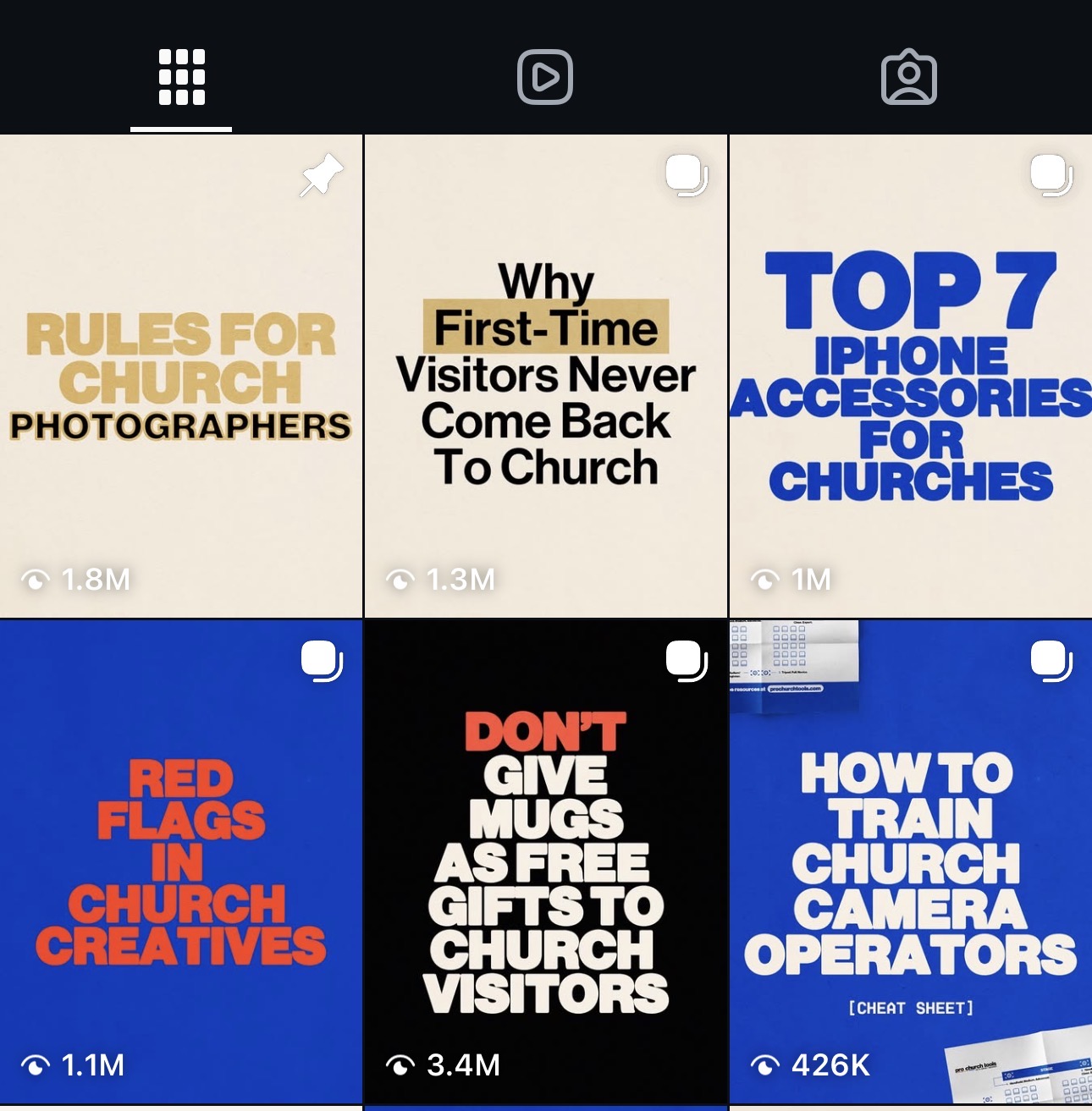
On my own Instagram, the final six posts I published in 2025 were reposts. Every one of them surpassed one million views except one, which reached half a million.
Reposting saves time and increases confidence. That combination matters in a demanding season.
The Metric You Need To Track
In this era, I am focusing less on how each individual post performs and more on a single metric: views per day.
Over a 90 day period, one of my YouTube channels with around 10,000 subscribers generated roughly 95,000 views. That averages to about 1,000 views per day.
Another channel with around 160,000 subscribers generated roughly 2,000 views per day in the same timeframe.
Sixteen times more subscribers only resulted in twice as many daily views.
The lesson is clear: obsessing over individual posts is less helpful than evaluating your combined output over time.
Views per day reflects the health of your overall content engine. It smooths out the volatility of any one post and gives you freedom to create without overanalyzing every result.
Followers Don’t Matter Like They Used To
Across Facebook, Instagram, YouTube, and TikTok, follower counts no longer guarantee distribution.
On my own Instagram account in the final quarter of 2025, 90 percent of views came from non-followers.
You are no longer entitled to space in your followers’ feeds.
This changes how churches should think about content. Posting a graphic about 21 days of prayer every day and expecting your followers to see it is not a reliable strategy.
Each post needs to stand on its own and reach beyond your existing audience. Social platforms prioritize content that connects with broader conversations.
For churches, this is an opportunity. The wisdom of Scripture applies to everyone. And every week, sermons are already being created. The raw material exists.
But it needs to be shaped for the current environment.
Content Equals Credibility
For years, your website functioned as the primary front door of your church. It still matters. But social profiles now share that responsibility.
People visit your Instagram and other platforms to evaluate your credibility. An inactive profile communicates something, even if you did not intend it to.
{{banner-2}}
An active presence serves three audiences:
First, your existing congregation. Distribution to followers may be lower than before, but it still happens.
Second, people discovering your church for the first time through recommended content. Most of what people see in their feeds now comes from accounts they do not follow.
Third, and most overlooked, people intentionally evaluating your church. They choose to visit your profile. They scroll. They assess.
Content equals credibility in that moment.
The Two Content Buckets
Every church needs two core content buckets: sermon content and photos of church life.
One of my core axioms for social ministry is the Principle of Congruency. Your online presence should reflect your in person experience.
Sermons are the largest portion of your Sunday gathering. To exclude them from your social presence would be incongruent. Sermon clips introduce viewers to your lead pastor, your theology, and your church’s personality.
Photos of church life communicate atmosphere. They help someone imagine what it would feel like to attend in person.
Together, these two categories provide clarity and alignment. They show who you are.
{{banner-3}}
Who You Are
You're a church staff member or a volunteer. Social media is a ministry that you probably didn't ask to be responsibile for. I'm here to serve you.
The truth is, creative formats will continue to evolve. Platform algorithms will continue to shift. But if you consistently publish sermon content and authentic photos of your community, your social presence will remain grounded and effective.
We are entering a new era of social media. The opportunity is still significant. It simply looks different than it did before.
Use these seven trends as guides. Focus on what matters. And build a social presence that reflects the life of your church with consistency and confidence.
Hey, It's Nice To Meet You
Hey there, I'm Brady Shearer. It's possible that some form of artificial intelligence brought you to this article, and if you made this far, I'll assume you're invested in this conversation.
I've been resourcing the church through Pro Church Tools for well over a decade, helping churches of every size navigate the communication shift of our time.
We publish weekly free resources on YouTube, our podcast, and Instagram, and we serve the church through our software called Nucleus.