People Are Asking ChatGPT To Find Them A Church. Is Yours Showing Up?
Brady Shearer
Apr 20, 2026
·
10
min read
Here's a scenario that's already happening all the time.
A family moves to a new city. They don't Google "churches near me." They open ChatGPT and type: "What are some welcoming, family-friendly churches near Franklin, Tennessee?"
Three seconds later, they get a curated list with descriptions, vibes, and even parking info. No ads. No scrolling through ten blue links. Just a direct recommendation from the AI that they beleve knows better than Google.
So here's the question: Is your church on that list?
If you're not sure, keep reading. We've got a simple five-step checklist and a new tool we've built specifically for this moment.
The Shift Is Happening, But Let's Get the Data Right
ChatGPT has 800 million weekly users as of early 2026. We're using it as a stand-in for all the big AI tools here - Claude, Perplexity, Gemini, Grok - the whole category. The behavior is the same across all of them.
52% of Americans use AI chat platforms at least weekly, according to SSRS/Edison Research. That number comes from a probability-based national panel of about 1,000 U.S. adults, and I'm flagging the methodology because a lot of data online is just a company surveying its own customers and publishing it like gospel. This isn't that.
The questions we used to ask Google or YouTube or our dads, we’re now asking of Large Language Models.
AI referral traffic also appears to convert dramatically better than traditional search. A Superprompt analysis of 12 million website visits found AI referral traffic converts at 14% versus Google organic at around 3%. Worth noting: Superprompt sells AI marketing tools, this was e-commerce and SaaS data, and the comparison is inherently skewed — AI referral traffic is pre-filtered by intent.
Still, the directional insight holds. People arriving from an AI recommendation are higher-intent visitors, and that matters for churches.
One Important Caveat
Orbit Media's data shows local and business queries are where AI chat has the weakest adoption. Only 24% of people prefer AI chat for local searches in 2026, down from 26% the year before. I get it. A year ago I asked an AI to help me plan a trip and it recommended a restaurant that had been closed for three years. AI tools are still catching up on local.
What this means for churches: you are not behind. You have time to build the runway before the plane lands. The churches that prepare now will have a real first-mover advantage when local AI search adoption catches up to where everything else already is.
How AI Decides Which Churches to Recommend
In the bygone digital era, Google cared about backlinks and domain authority. There were entire ecosystems built around it: guest posts, link exchanges, forums where people traded backlinks like currency.
We're past all of that now.
AI engines look for three things:
Structured data
Consistent contact information
Rich answer-formatted content
Structured data (schema markup) is the most important and most overlooked. It's HTML code in the base layer of your website that visitors never see, but AI bots can parse easily. It tells them who you are, where you are, what you believe, and what you offer. If that sounds complicated, take a deep sigh of relief here. You don't need to know how to code.
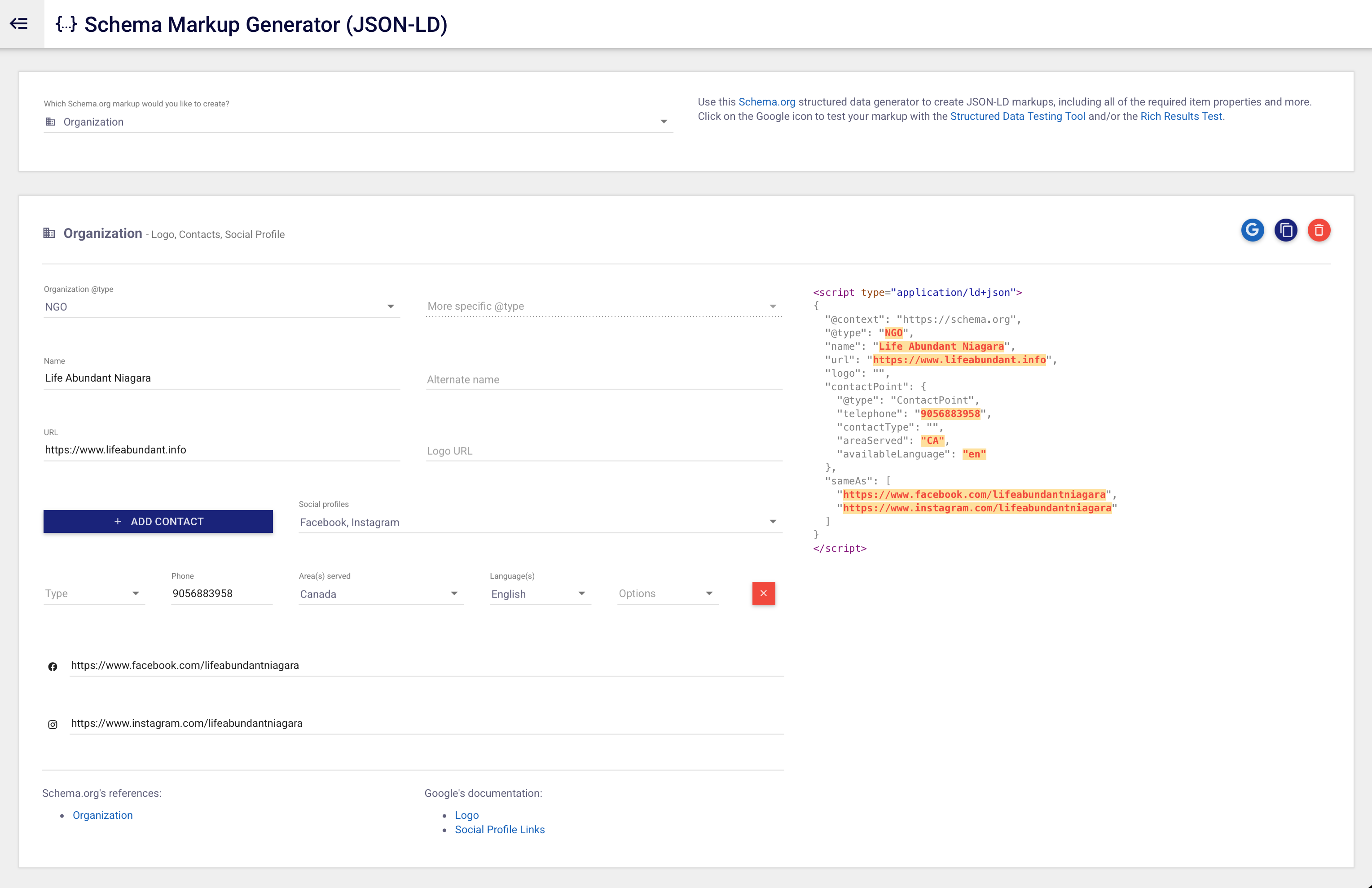
Simply go to a schema generator tool like technicalseo.com, choose the Organization type, fill out the form, click generate, and you'll get a 12-to-14 line HTML snippet. Copy it into the code injection area of your website builder – Squarespace, Wix, and Nucleus all have this. Five minutes.
Consistent NAP data (Name, Address, Phone number) needs to be identical everywhere: your website footer, Google Business Profile, Apple Maps, Yelp, every directory. When your website says one thing and your Google Business Profile says something different, an AI literally doesn't know which answer to give the person asking about you.
Rich, answer-formatted content is your FAQ pages, What to Expect page, Plan a Visit page – anywhere you've directly answered the questions real people are typing into AI. "What should I wear?" "Do you have programs for kids?" "Where do I park?" If you've written it down somewhere crawlable, the AI can use it.
A Story To Put Flesh On This Idea
My friend and co-host on the Pro Church Tools Show, Alex, is a pastor of a rural church in Niagara. A few Sundays ago, a new family walked through the door. Alex went to welcome them and asked what brought them in.
The woman said she'd been talking to ChatGPT.
Her exact words: "Chat knows that I'm reading Practicing the Way by John Mark Comer. So when I searched for a church, your church came up as one that would fit that vibe."
Alex went home and thought about it. A year and a half ago, his church had run the Practicing the Way course as a small group. He'd built a landing page for signups. That page was still live, although it was no longer linked anywhere in the navigation. It just existed on the internet.
ChatGPT had found it. It built a picture of what life at that church looked like based on everything ever published there, and it matched a woman reading a specific book with a church that had engaged with that same material.
{{banner-1}}
And this woman didn't walk in hoping something would connect. She walked in with a degree of confidence that this might be the right place. Visiting church for the first time is vulnerable — you're walking into a room full of strangers hoping something resonates. Arriving pre-matched to a church that has visibly done the things you care about is a completely different experience.
I was talking with Alex about this later and his reflection was maybe that page should stay up forever. Maybe he should be thinking about his website differently. Maybe more content — content with some longevity — is the move.
He's right.
Introducing Nucleus Posts: A Home for Every Ministry
This is where we get to talk about something we've been building.
One of our foundational communication principles at Nucleus is that every ministry needs a home. Not every ministry needs a full page, but every ministry needs somewhere online where information accumulates over time.
Most importantly, a home where everyone can find all the information that they need.
Alex's Practicing the Way landing page worked because it existed. Imagine if he'd been intentional about it. Imagine if every ministry at his church had its own running collection of content like updates, events, recaps, and announcements building up over months and years.
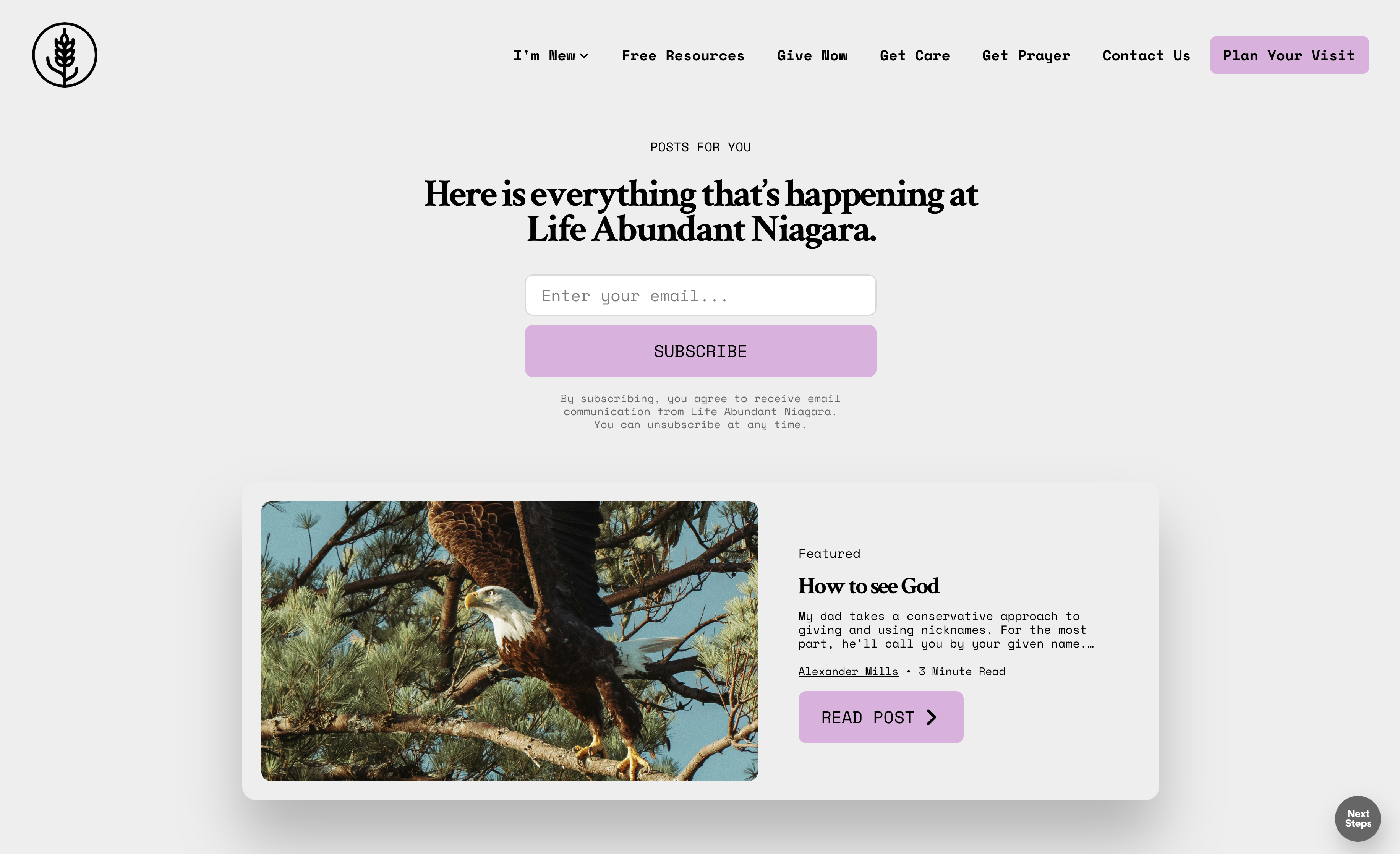
That's exactly what we built. Nucleus Posts is live, and it's the central hub for all your church communications.
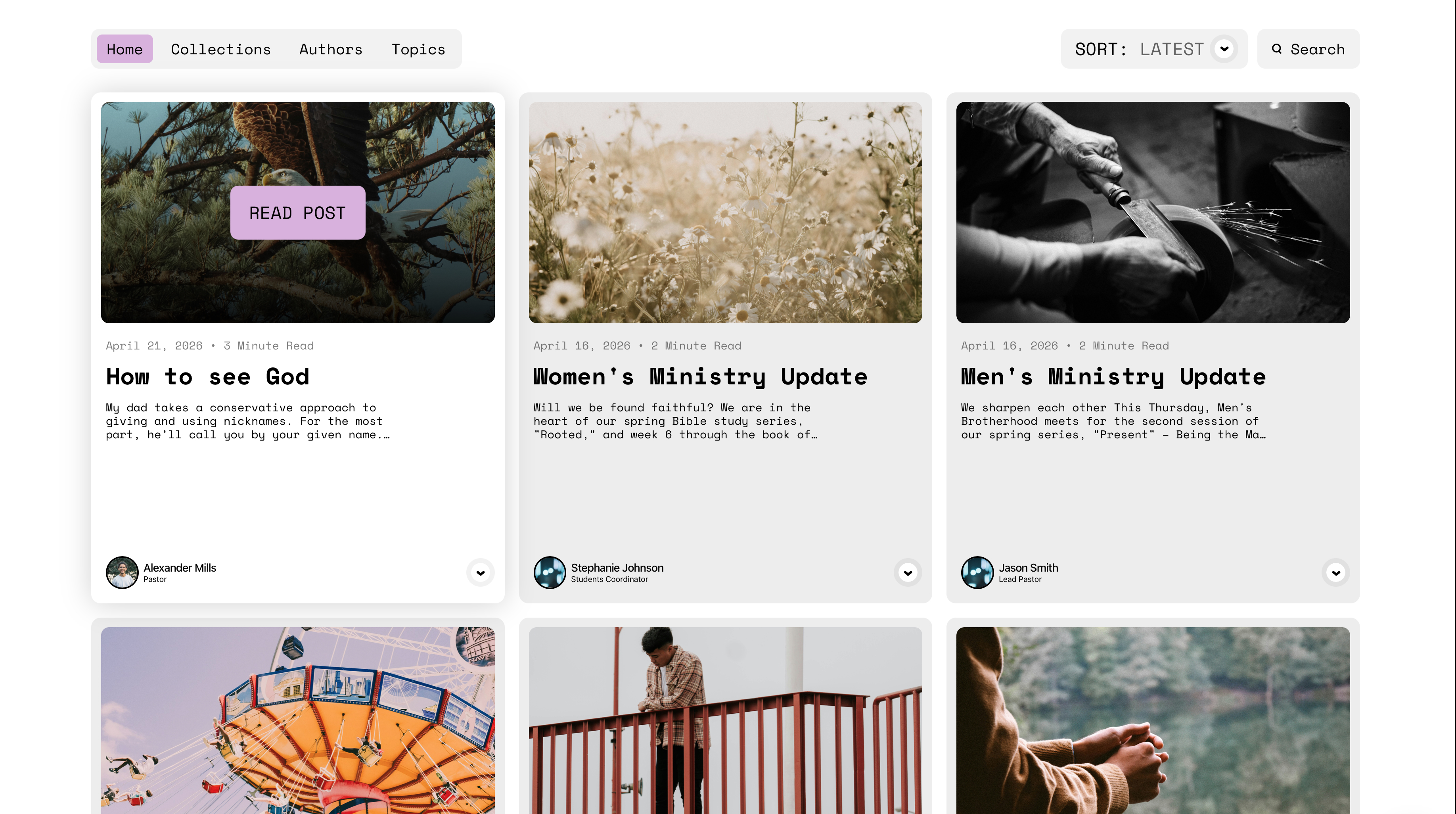
Posts lets you create collections for every ministry in your church.
Think of a collection like a playlist. The playlist is "Men's Ministry" and each post is a new entry – a recap of last month's event, a photo from the pancake breakfast, an announcement for what's coming. When we build new sites for churches through our free makeover program at nucleus.church, we set these collections up for you automatically. You just fill in the details.
Here's why this matters for AI search:
Density and specificity are what create confident matches. If someone asks an AI for a church with a strong men's ministry and your church has a post collection with two years of men's ministry updates, the AI doesn't just know your church has a men's ministry — it knows what that ministry has actually been doing. It can tell someone: "Yeah, Life Abundant has a really active men's ministry. They had a pancake breakfast last month and a camping trip in the fall."
That specificity is what gets someone through the door already feeling like they belong.
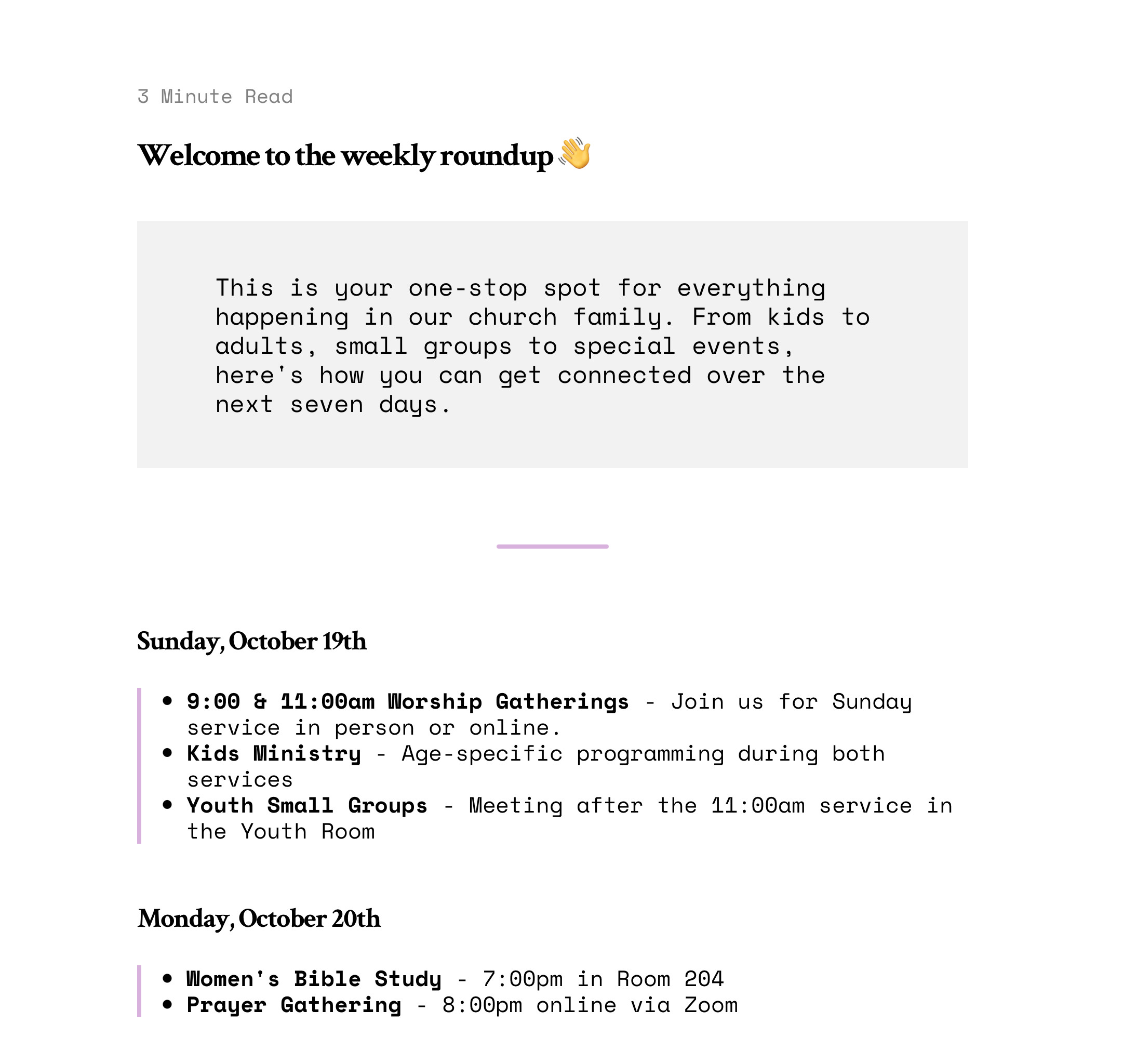
The easiest place to start is a weekly bulletin. The bulletin is your church's record of truth, documenting everything happening across every ministry. Post it every week as a Nucleus Post, throw a QR code on a slide at the top of service, and you're building an AI-citable archive of your church's life without doing anything extra. An LLM can scrape a year of bulletins and build a detailed, accurate picture of who your church is.
The 5-Step Church AI Visibility Checklist
Step 1: Claim and optimize your Google Business Profile. Non-negotiable. Complete every field, add photos regularly, respond to every review.
Step 2: Add structured data to your website. Use a free generator like technicalseo.com, get your schema snippet, paste it into your website's code injection area. Make sure your name, address, and phone number are in the footer on every page.
Step 3: Build a robust What to Expect page. Write it in Q&A format. Answer every question a first-time visitor would ask. This is the content AI loves to cite. And the bigger principle here: give every ministry a home. A What to Expect page is just one example. Nucleus Posts is how you do it at scale.
Step 4: Get listed in church directories. Church Finder, Find a Church, your denominational directory, your local business directory. Each one is a citation that adds credibility with AI engines.
Step 5: Ask for Google reviews consistently. This might be the most overlooked. A church with 47 reviews at 4.8 will get recommended over a church with 3 reviews at 5.0. When I asked Claude to recommend Airbnbs in Cape Town without mentioning reviews, it came back with options that all had 20+ reviews and flagged the ones that didn't as a negative. That's just how these models think.
And when it comes to reviews, you have a unique advantage here as a church.
Google reviews are tied to your mission. Consider giving it a stage announcement on Sunday morning, saying: "There are new families moving into the neighborhood down the road. The first thing they'll do when they want to find a church is ask Google. If you believe in what God is doing here, take out your phone right now and leave us a review."
That's not a weird ask. It's a mission ask.
Start Now, Get Ahead
AI-assisted search is mainstream for product research and information queries. For local discovery — finding a church, a restaurant, a mechanic — it's still earlier-stage. But it's heading in the same direction, and the churches building their digital foundation now will be the ones AI recommends when local search adoption catches up.
If you want us to do the heavy lifting, go to nucleus.church. We'll build you a free church website with Post Collections and homes for every ministry in your church — all you have to do is keep it updated.
The era of gaming Google is over. What has replaced it rewards churches for communicating who they genuinely are. Your digital footprint is now a direct reflection of your in-person reality. Build it well, keep it current, and the right people will find you.
{{banner-2}}
Hey, It's Nice To Meet You
Hey there, I'm Brady Shearer. It's possible that some form of artificial intelligence brought you to this article, and if you made this far, I'll assume you're invested in this conversation.
I've been resourcing the church through Pro Church Tools for well over a decade, helping churches of every size navigate the communication shift of our time.
We publish weekly free resources on YouTube, our podcast, and Instagram, and we serve the church through our software called Nucleus.